

Featured News Item

Question of the Month
This feature presents some of the interesting queries we receive, and highlights how we can direct you towards the appropriate resources.
Question: What are the requirements for entitlement to spousal support?
Answer: Prior to 1985, maintenance orders in Canadian family law were generally conceived as temporary measures. Courts adhered to a “clean break” model, which emphasized the promotion of economic self-sufficiency following marital breakdown. This approach was reinforced by a series of decisions in 1987, commonly referred to as the “spousal support trilogy”, which addressed agreements providing for time-limited support. Under this framework, a claimant was required to demonstrate that their inability to achieve self-sufficiency was causally connected to the marriage. In practice, this often resulted in limited support for spouses (usually women) who had foregone career opportunities to assume domestic roles.
The legal landscape shifted significantly with the Supreme Court of Canada’s decision in Moge v Moge, [1992] 3 S.C.R. 813. In Moge, the Court recognized marriage, particularly long-term marriage, as an economic partnership, thereby affirming that its dissolution may give rise to ongoing support obligations. While Moge primarily addressed long-term marriages, the Court expanded the conceptual basis for entitlement in Bracklow v Bracklow, [1999] 1 S.C.R. 420. In that case, the Court articulated three distinct grounds for spousal support: (1) compensatory, (2) contractual, and (3) non-compensatory (or needs-based).
Statutory guidance on entitlement is found in s. 15.2 of the Divorce Act, R.S.C. 1985, c. 3 (2nd Supp.), which directs courts to consider;
(a) the length of time the spouses cohabited;
(b) the functions performed by each spouse during cohabitation; and
(c) any order, agreement, or arrangement relating to the support of either spouse.
It should be noted that the Divorce Act applies only to legally married spouses. In Manitoba, entitlement for common-law partners is governed by The Family Law Act, which extends rights and obligations to individuals who have registered their relationship, cohabited for at least one year and share a child, or cohabited for a minimum of three years.
Both the Divorce Act and The Family Law Act reflect a dual objective: to address economic disadvantage arising from the breakdown of a relationship while also encouraging parties to become self-sufficient. However, in Leskun v Leskun, [2006] 1 S.C.R. 920, the Supreme Court clarified that self-sufficiency is not a strict legal duty.
“27 Failure to achieve self-sufficiency is not breach of “a duty” and is simply one factor amongst others to be taken into account.”
The Court would also limit the use of review orders, holding that variation of a final support order requires proof of a “material change in circumstances”, thereby reinforcing the principle of finality in spousal support determinations.
If you are looking for more information on Spousal support, Family Law, or any other legal topics, email us for resources, commentary, and research assistance.
Latest Current Awareness
Newsletters
One of our many services is the distribution of legal newsletters. Our subscriptions with Lexis+ and Westlaw Canada allow us to share their newsletters with members of the Law Society of Manitoba. These newsletters cover all areas of law. For one example of what we offer, check out the latest on employment law with this popular title available from LexisNexis.
Labour Notes Newsletter
A weekly digest of legislative developments in employment, human rights, labour, pay equity and employment insurance law across Canada, including ground-breaking cases and feature articles.
The latest issue highlights matters on:
Contractual changes: In Comeau v Valcom Consulting Ltd, 2025 NBKB 253 the Court of King’s Bench of New Brunswick held that an employer’s attempt to unilaterally introduce new, more restrictive terms of employment in relation to a long-term employee who had worked under a series of fixed-term employment agreements constituted a constructive dismissal.
Human Rights jurisdiction: BC-based employers might hire employees who reside outside British Columbia. In those circumstances, the employers should take care to consider whether they are bound by the BC Human Rights Code (the “Code“) or the legislation applicable in the province or other jurisdiction in which the employees are situated.
If you would like to subscribe to any of these publications, please email library@lawsociety.mb.ca to be added to the distribution list.
Journals
Manitoba Law Library subscribes to a number of legal journals in print and digital. See below for the latest issues of popular titles. Members can request copies of articles under fair dealing guidelines by emailing library@lawsociety.mb.ca
National Journal of Constitutional Law
Canada's forum for discussing and analyzing constitutional law issues that affect practitioners. Each issue includes insightful analysis and discussion of human rights issues, Charter issues, and division of power issues.
The latest issue (March 2026) includes contributions celebrating the legacy of Peter Hogg.
New Library Resources
New Print Titles
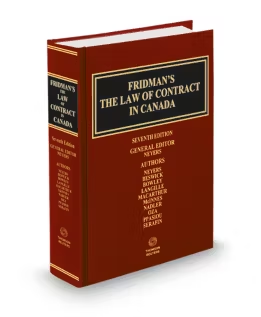
Fridman's The Law of Contract in Canada, 7th ed.
The 7th Edition contains the most current developments in Canadian contract law including:
New chapters:
- Intention to Contract (Chapter 3): including a discussion of Ethiopian Orthodox Tewahedo Church of Canada St. Mary Cathedral v. Aga, 2021 SCC 22: intention to contract in a voluntary religious association.
- Promissory Estoppel (Chapter 5) : sections distinguishing estoppel from other doctrines and discussing its future as an independent cause of action in Canada; discussion of Trial Lawyers Association of British Columbia v. Royal & Sun Alliance Insurance Company of Canada, 2021 SCC 47: the requirements of a promissory estoppel.
- Good Faith (Chapter 18): addressing the general organizing principle of good faith performance in contract flowing from Bhasin v. Hrynew (2014 SCC), including treatments of C.M. Callow Inc. v. Zollinger (2020 SCC) and Wastech Services Ltd. v. Greater Vancouver Sewerage and Drainage District (2021 SCC).
Canadian pluralism and the Charter : moral diversity in a free and democratic society
"This text comprises a collection of papers examining how government and decision-makers approach issues related to competing morals and values, and how such differences may be accommodated in a free and democratic society. The issues explored are becoming intensely pertinent as Canada’s religious diversity increases, the state expands into areas traditionally seen as private, and state actors seek to promote certain ‘values’. " - from publisher

Financial Principles Of Family Law
"It is the only reference of its kind to incorporate all of the financial aspects of marital dissolution. It includes valuation, taxation, Federal Child Support Guidelines, income determination, and case law analysis, all in one place.
This comprehensive, easy-to-use reference also includes:
- A detailed analysis of valuation concepts, terminology, and methodologies for the valuation of business interests and other types of assets and liabilities, balanced with relevant case law analysis giving you the tools to prepare for the examination for discovery and cross-examination of other experts
- How to calculate income under the Federal Child Support Guidelines
- An entire section devoted to practical issues, including disclosure requirements, structuring and financing the equalization payment, and domestic contract provisions relating to the value
- A comprehensive section devoted to the taxation aspects of family law
- A new chapter on the role of an independent expert
- All the latest developments in the law relevant to valuation, child support, and taxation" - from publisher
Anger & Honsberger Law of Real Property, 3rd ed.
"This examination of the general principles of real property law includes the most recent case law and statutes, with an expansive review of estates, trusts, mortgages, the law of perpetuities, titles, planning legislation, and more. The third edition also added new chapters on water law, Crown lands and aboriginal property interests. The work is dedicated to the basic principles of real property as well as addressing the practical application of those principles. The seminal work has maintained its status as a first resource on real property law." - from publisher

Review taken from the Canadian Law Library Review, Vol. 50 Issue #3

The Legal Brain: A Lawyer’s Guide to Well-Being and Better Job Performance. By Debra S. Austin.
Reviewed By
Leslie Taylor
Research and Instruction Librarian
Lederman Law Library
Queen’s University
"The Legal Brain: A Lawyer’s Guide to Well-Being and Better Job Performance by Debra S. Austin provides an approach to supporting and enhancing lawyer well-being that is focused on brain health. Austin, a law professor at the University of Denver Sturm College of Law and a nationally recognized expert in lawyer well-being, is well qualified to offer such guidance. While there has been a proliferation of self-help books written on the topic of lawyers’ mental health and well-being in recent years, what makes Austin’s book stand out is the way in which she grounds her approach in concrete neuroscience research, offering evidence-based strategies that appeal to lawyers’ analytical nature. "
Events
Upcoming Events
CIAJ 2026 Annual Conference | Reimagining Law and Justice Through Restorative Approaches
Celebration of Justice Glenn Joyal’s Appointment to the Supreme Court of Canada
CIAJ Conference | Understanding Maritime Law in Practice: A Bench & Bar Conference
Substantive Law
Aboriginal Law
Brokenhead Ojibway Nation v Nelson, 2026 MBCA 26: Motion made under section 25.2(1) of The Court of Appeal Act, for leave to appeal an interlocutory order denying a motion brought by the Moving Parties to vary a representation order made by a MBKB judge on a consent basis, per rule 10.01 of the MB, King’s Bench Rules, and to be relieved of the binding effect of the representation order per rule 10.03. The test for leave to appeal was set out in Knight v Daraden Investments Ltd et al, 2022 MBCA 69. Moving Parties were granted leave to appeal on six of their nine proposed grounds.
Bankruptcy Law
Stewart v Auch, 2026 MBCA 21: Appeal of an order for a debt to not be released by any order of discharge from bankruptcy pursuant to section 178(1)(e) of the Bankruptcy and Insolvency Act. The application judge considered the test set out in Poonian v British Columbia (Securities Commission), 2024 SCC 28. At para. 23 the court writes, “We disagree with the respondent as to the applicable standard of review in this appeal; it is not correctness. The legal effect of the respondent’s actions under section 178(1)(e) of the BIA is a question of mixed fact and law, absent an extricable principle of law (see Garlicki (Bankrupt), Re, 2010 MBCA 73 at paras 24-29). In our view, there is no readily extricable question of law in this case; this is a situation about whether a set of facts satisfies the relevant legal standard, nothing more.” Appeal dismissed.
Civil Litigation
Wiebe et al. v. Wiebe, 2026 MBKB 46: Relief sought under The Mental Health Act under s. 101(1)(a), s. 101(1)(b), ss. 81(1) and 92. A good overview of the relevant considerations can be found in Kennedy et al. v. McKenzie, 2020 MBQB 139, at paras. 18-20. Parties agreed the applicable test is set out in Smith et al. v. Smith et al., 2007 MBQB 126. Applicant’s relief was granted.
Poplar River First Nation v. His Majesty the King in the Right of Canada et al., 2026 MBKB 43: Decision regarding the preliminary issue of jurisdiction on a motion for an interim and interlocutory injunction. S. 22 of the Crown Liability and Proceedings Act and common law principles of Crown immunity generally prohibit the injunctive relief sought by Plaintiff. Exceptions include: a challenge to the constitutionality of legislation, jurisdiction can be found in s. 24(1) of the Canadian Charter of Rights and Freedoms (RJR‑MacDonald Inc. v. Canada (Attorney General), 1994 CanLII 117). Another example is where an interim preservation order is granted to protect unique property rights (Couchiching First Nation v. Attorney General of Canada, 2010 ONSC 4373). No exceptions were found to apply in this case. The Court found the MBKB does not have jurisdiction and dismissed the motion.
10042210 Manitoba Inc. et al. v. The City of Winnipeg, 2026 MBKB 35: Applicant filed 8 actions. Respondents include the city of Winnipeg, the Manitoba's attorney general and ADM of finance, and the attorney general of Canada. Respondents request the claims filed against them to be dismissed or struck, except for one claim in which they seek to have a vexatious litigant order made against the applicant. Legal test for applications to strike frivolous and vexatious proceedings or proceedings to constitute an abuse of process was described Nygård International Partnership v. Canadian Broadcasting Corporation et al., 2011 MBQB 124. Re Lang Michener v. Fabian, 1987 CanLII 172 (ON SC), provides a non-exhaustive review of the type of conduct that often marks the conduct of a vexatious litigant. All but one matter was struck and the applicant was deemed to be a vexatious litigant.
The Canadian Broadcasting Corporation. v. Bostock and Manitoba Prosecutions Services; Strutinsky v. The Canadian Broadcasting Corporation, Manitoba Prosecutions Services, 2026 MBPC 21: Applications related to public access to judicial authorizations and orders issued during a criminal investigation of members of the Winnipeg Police Service. The legal test the applicant must meet has been set out most recently in Sherman Estate v. Donovan, 2021 SCC 25. Applicant cited R. v. Minassian, 2019 ONSC 4455 to reject the notion that witness tainting poses a serious risk to an important public interest, as in most cases it is entirely speculative. The application to lift the publication ban was lifted, and the application to impose a publication ban was dismissed with the caveat that personal information be redacted before release.
Corporate and Commercial Law
Burton v. Bison Conservation Ranch Ltd. et al., 2026 MBKB 36: Request to produce documents and examine directors. This application involves a network of family-owned trusts and companies. Applicant seeks relief under s. 234 of The Corporations Act. The basic principles underlying oppressive actions and available remedies are set out in BCE Inc. v. 1976 Debentureholders, 2008 SCC 69. The court found the applicant established a strong prima facie case of unfair prejudice. Respondents ordered to provide specific documents and information related to Bison's financial statements and transactions within 60 days.
Criminal Law
R v Henderson, 2026 MBCA 28: Sentence appeal and motion to submit fresh evidence. When the accused pled guilty, she did so because she believed a CSO was legally available. In R v Fice, 2005 SCC 32 the Supreme Court of Canada notes that a court cannot make a CSO available by applying pre-sentence custody to reduce a penitentiary sentence to one of less than two years and then grant a CSO. That legal error rendered her guilty pleas uninformed. The criteria needed for a guilty plea to be considered valid is found in R v Wong, 2018 SCC 25. The accused’s guilty pleas were set aside and a new trial was ordered.
R v Comber, 2026 MBCA 27: Issues on appeal are if the trial judge's interventions during the defence's cross-examinations result in an unfair trial, and was the jury's verdict of second-degree murder unreasonable considering the principles set out in R v Villaroman, 2016 SCC 33. Among others, R v Samaniego, 2022 SCC 9 is cited regarding the gatekeeping function of a judge during cross-examination. It was found that the trial judge acted appropriately. Standard of appellate review of the jury’s murder verdict under section 686(1)(a)(i) of the Code is whether the verdict is one that a properly instructed trier of fact, acting judicially, could reasonably have rendered. The court highlights that they are not to act as a “13th juror” (R v WH, 2013 SCC 22). At para. 207, the court states, “In terms of a remedy, while the accused was not properly convicted of second degree murder, I believe that no properly instructed jury acting reasonably could have reached a conclusion more favourable to him on this record other than that he was guilty of the lesser included offence of manslaughter (see the Code, ss 686(1), 686(3); R v Turner, 2023 MBCA 40 at para 55).”
Family Law
Zangana v. Noubani, 2026 MBKB 45: Respondent/Petitioner seeks annulment of marriage. In depth discussion of the law of annulment in Canada, citing Lowe v. A.A., 2018 ONSC 3509. The Respondent/Petitioner failed to show grounds for annulment. Petition dismissed.
Polowy v Kelly, 2026 MBCA 22: Appeal of motion judge’s dismissal of the respondent's motion for summary judgment, finding that promissory estoppel barred the respondent from relying on the limitation period. It was found the motion judge misapprehended the evidence, incorrectly finding that the material facts were largely undisputed and that credibility issues were limited. The motion judge erred by not applying the correct law regarding promissory estoppel, did not outline the governing principles of promissory estoppel, and did not cite the leading Supreme Court cases in Maracle v. Travellers Indemnity Co. of Canada, 1991 CanLII 58 (SCC). Appeal allowed to the extent of setting aside the motion judge’s decision regarding promissory estoppel and directing that the issue of whether the petitioner’s claim is barred by the limitation period be determined at a trial.
Legislation
Federal
Recent Votes
Provincial
Recent Bill Activity
| Bill number | Title | 1st Reading | 2nd Reading | 3rd Reading | Royal Assent | S.M. Chapter | Date |
| 3 | The Manitoba Public Insurance Corporation Amendment Act | 24-Nov-25 | 04-Mar-26 | ||||
| 4 | The Constitutional Questions Amendment Act | Mar 4, 2026 | 05-Mar-26 | ||||
| 5 | The Accessibility for Manitobans Amendment Act and The Commemoration of Days, Weeks and Months Amendment Act (Access Awareness Week) | Mar 10, 2026 | 16-Mar-26 | ||||
| 10 | The Employment Standards Code Amendment Act (Attachment Leave for Adoption and Surrogacy) | Mar 5, 2026 | 11-Mar-26 | ||||
| 15 | The Consumer Protection Amendment Act | Mar 11, 2026 | |||||
| 17 | The Adult Abuse Registry Amendment Act | Mar 5, 2026 | 12-Mar-26 | ||||
| 20 | The Manitoba Hydro Amendment Act | Mar 12, 2026 | |||||
| 21 | The Drinking Water Safety Amendment Act | Mar 11, 2026 | |||||
| 23 | The Advocate for Children and Youth Amendment Act | Mar 10, 2026 | 16-Mar-26 | ||||
| 26 | The Health System Governance and Accountability Amendment Act (Eliminating Mandatory Overtime for Nurses) | Mar 11, 2026 | |||||
| 27 | The Declaration of Principles for Patient Health Care Act and Amendments to The Health System Governance and Accountability Act | Mar 9, 2026 | |||||
| 28 | The Health System Governance and Accountability Amendment Act (Nurse-to-Patient Ratios) | Mar 11, 2026 | |||||
| 30 | The Intimate Partner Violence Death Review Committee Act | Mar 5, 2026 | 09-Mar-26 | ||||
| 31 | The Highway Traffic Amendment Act | Mar 5, 2026 | 10-Mar-26 | ||||
| 32 | The Improving Access to Breast Cancer Screening Act | Mar 10, 2026 | |||||
| 33 | The Planning Amendment and City of Winnipeg Charter Amendment Act | Mar 5, 2026 | 17-Mar-26 | ||||
| 34 | The Interprovincial Subpoena Amendment Act | Mar 10, 2026 | |||||
| 36 | The Child and Family Services Amendment Act | Mar 12, 2026 | 17-Mar-26 | ||||
| 37 | The Environmental Statutes Amendment Act | Mar 12, 2026 | |||||
| 38 | The Public Schools Amendment and Manitoba School Boards Association Amendment Act | Mar 12, 2026 | |||||
| 39 | The Manitoba Hydro Amendment and Tax Administration and Miscellaneous Taxes Amendment Act | Mar 12, 2026 | |||||
| 40 | The Elections Amendment Act | Mar 12, 2026 | 19-Mar-26 | ||||
| 41 | The Promoting Inclusion in Amateur Sport Act | Mar 12, 2026 | |||||
| 42 | The Motor Vehicle Statutes Amendment Act | Mar 12, 2026 | |||||
| 43 | The Highway Traffic Amendment and Drivers and Vehicles Amendment Act | Mar 12, 2026 | |||||
| 44 | The Minor Amendments and Corrections Act, 2026 | Mar 12, 2026 | |||||
| 45 | The Yellowquill University College Act and Amendments to The Advanced Education Administration Act | Mar 12, 2026 | |||||
| 46 | The Securities Amendment Act | Mar 12, 2026 | |||||
| 47 | The Apprenticeship and Certification Amendment Act | Mar 12, 2026 | |||||
| 48 | The Real Property Amendment and Planning Amendment Act (Land Conveyed for Public Purposes) | Mar 12, 2026 | |||||
| 49 | The Business Practices Amendment Act | Mar 12, 2026 | |||||
| 50 | The Pharmaceutical Amendment, Regulated Health Professions Amendment and Public Health Amendment Act | Mar 12, 2026 | |||||
| 51 | The Public Sector Artificial Intelligence and Cybersecurity Governance Act | Mar 17, 2026 | |||||
| 52 | The Interim Appropriation Act, 2026 | Mar 25, 2026 | 25-Mar-26 | Mar 25, 2026 | 25-Mar-26 | S.M. 2026, c. 1 | 25-Mar-26 |
| 201 | The Employment Standards Code Amendment Act (Right to Religious Observance) | Mar 24, 2026 | |||||
| 202 | The Financial Administration Amendment Act | Mar 24, 2026 | |||||
| 203 | The Correctional Services Amendment Act | Mar 19, 2026 | |||||
| 204 | The Timely Construction of Residential Housing Act | Mar 12, 2026 | |||||
| 205 | The Milk Prices Review Amendment Act | Mar 12, 2026 | |||||
| 216 | The Elections Amendment Act (Election Day on Saturday) | Mar 19, 2026 | |||||
| 217 | The Celebration of Philippine Independence Day Act (Commemoration of Days, Weeks and Months Act Amended) | Mar 18, 2026 | |||||
| 230 | The Moose Hide Campaign Day Act (Commemoration of Days, Weeks and Months Act Amended) | Mar 9, 2026 | |||||
| 231 | The Indigenous Heritage Month Act (Commemoration of Days, Weeks and Months Act Amended) | Mar 9, 2026 | |||||
| 232 | The Autism Strategy Act | Mar 16, 2026 | 19-Mar-26 | ||||
| 233 | The Municipal Assessment Amendment Act | Mar 18, 2026 | |||||
| 234 | The Registered Landscape Architects Act | Mar 26, 2026 |
New Regulations